Still mission-critical, running out of support
Oracle Forms lets teams build data-entry and transaction screens directly on Oracle Database, with the business logic held in triggers and PL/SQL. Banks, insurers, utilities and public bodies built core systems on it, and thousands still run them, often with thin documentation.
- 10,000+organizations still run Oracle Forms today1
- 1 in 5companies still run more than 1,000 forms in their portfolio2
- 12%of companies do not have all .fmb source files for their Forms2
Versions still in use, and what Oracle supports
| Version | Oracle support today |
|---|---|
| 6i and earlier | Desupported Desupported years ago. No patches. |
| 10g and 11g | Sustaining Support only No new fixes or security patches. |
| 12c (12.2.1.x) | Premier Support ends 31 Dec 2026 Paid Extended Support to 31 Dec 2027. |
| 14c (14.1.2) | Supported Released Dec 2024. Premier to Dec 2030, Extended to Dec 2033. |
Why staying on Forms gets riskier in 2026 and 2027
Security patches stop
From January 2027, 12c patches need paid Extended Support. From 2028, there are none at all.
Audit and compliance pressure
In banking, insurance, energy and government, unsupported middleware quickly becomes an audit finding.
Knowledge walks out
The people who understand these systems retire or move on, and their knowledge often leaves with them.
Upgrading only buys time
Moving to 14c extends support to 2030, but it is a project of its own, and you are still on Forms.
Sources: 1 6sense (12,237 companies) and Enlyft (11,980 companies), 2026. 2 Kodesage webinar poll, 100 respondents across UKOUG and DOAG webinars, 2026. Support dates: Oracle Fusion Middleware Lifetime Support Policy.
Why migration is now a must
Extended Support and the 14c upgrade both move the deadline, but neither removes the risk. Every year on Forms adds change requests to a platform fewer people can work on, and pushes the eventual migration closer to a hard stop. Organizations that start now migrate on their own timeline, not Oracle's.
is what Forms migrations have traditionally meant, along with seven-figure budgets and business logic at risk. Most of that time goes into understanding the system, not rewriting it.
Why Forms migrations stall
Logic nobody documented
Business rules sit in triggers, program units and PL/SQL libraries written decades ago, often by people who have left.
It is not a file conversion
Forms built-ins, client-side code, WebUtil and OLE2 calls have no direct web equivalent and need redesign.
Everything depends on everything
Forms call each other and share libraries, so modules have to move in dependency-aware waves.
Oracle's own converter is gone
The APEX migration wizard was desupported in APEX 21.1. Forms2XML only helps with analysis.
Missing source files
Some portfolios have lost .fmb files, so parts of the system must be recovered from the running application.
Proving it still works
A page that loads is not proof. Data, permissions, integrations and outcomes all need testing against the original.
The five steps every Forms migration goes through
- Step 1Discover and inventory the portfolio
- Step 2Choose the target stack and approach
- Step 3Plan dependency-aware waves
- Step 4Convert, rebuild and validate
- Step 5Cut over and support
How much of a Forms migration can AI automate today?
General-purpose LLM coding agents can produce plausible APEX or Java in minutes. On a Forms portfolio, that is the problem: where source is missing or logic is ambiguous, they guess, and a guess looks exactly like a correct answer until acceptance testing.
A PRE-INSERT trigger calls GEN_ACCOUNT_NO, but there is no source for that package. A model that guesses gives you a working app that generates the wrong account numbers. Kodesage flags it instead, and a person decides.
What we measured
Kodesage results on a deliberately hard sample application with 610 constructs, as presented at our 2026 UKOUG and DOAG webinars.
- 7.5 sper form to analyze in discovery, fully deterministic, no LLM
- 15–60 minper form for the agent migration loop, until all checks pass
- ~2.5 hof human review per complex form
- ~80%of use cases recovered from the running app alone, with no source
Why we quote 52%, not 83%. Work flagged for review only counts once someone has checked it. Any vendor quoting “90% automated” should be able to tell you who checks the rest, and how.
Rules govern, AI proposes, humans decide
Kodesage parses every form into an internal model before any AI is involved. A deterministic rulebook, the codex, converts everything that has one right answer. LLM agents only work inside the options the rules allow, and anything that needs judgment goes to a person with the full trace attached.
| Who | Does | Never does |
|---|---|---|
| Deterministic rules | Migrate the UI (pages, regions, items, LOVs, menus) and map the PL/SQL. Same input, same output, every run. | Guess. Where the rules cannot decide, they list the options. |
| AI agents | Pick from the options the rules allow, write PL/SQL bodies where needed and fix test findings in a loop. | Invent a table, call or form, or set their own confidence. |
| Your engineers | Override, redesign what should not be copied 1:1, and decide anything the source cannot answer. | Start from zero. Every flagged item comes with its full trace. |
The loop, for every form
- 1 · BuildRules build the app and map the logic to its new place.
- 2 · CompleteThe agent fills in the logic the rules cannot translate.
- 3 · CheckA page check against the spec, a Klicker agent test and a codex review.
- 4 · ReviewFindings loop back until checks pass. Then a human reviews.
Kodesage ships with an open-weight model that runs on a single 80 GB GPU, on-premises by default and air-gapped if needed. Any OpenAI-compatible endpoint works too, and you can switch to a proprietary model if your policies allow data to leave your environment. We keep benchmarking alternatives, so you are never locked into one model maker.
Faster than a traditional project, without giving up control
Consultants use AI tools too. The difference is what the AI works from and who decides. Kodesage starts from a knowledge layer built in discovery, covering every form, trigger, dependency and database object, and from a playbook shaped by 20 years and hundreds of modernization projects.
| Typical consulting project | With Kodesage | |
|---|---|---|
| Discovery | Weeks of workshops, interviews and spreadsheets | Inventory, complexity scores and a migration plan in days |
| Conversion | Engineers prompt general AI tools, module by module | Rules convert what they can, agents work inside them |
| Validation | Testers write and click through manual test scripts | The Klicker agent runs natural-language test scenarios on the Forms app and the new one, and flags every deviation |
| Knowledge | Leaves with the consultants at the end | Stays in a documented knowledge base you own |
- 3xfaster discovery and migration
- 50%of traditional project cost
- 100%test pass rate before go-live
See these numbers on your own Forms portfolio
Full inventory, complexity scoring and a migration plan in 2 weeks, run in your environment.
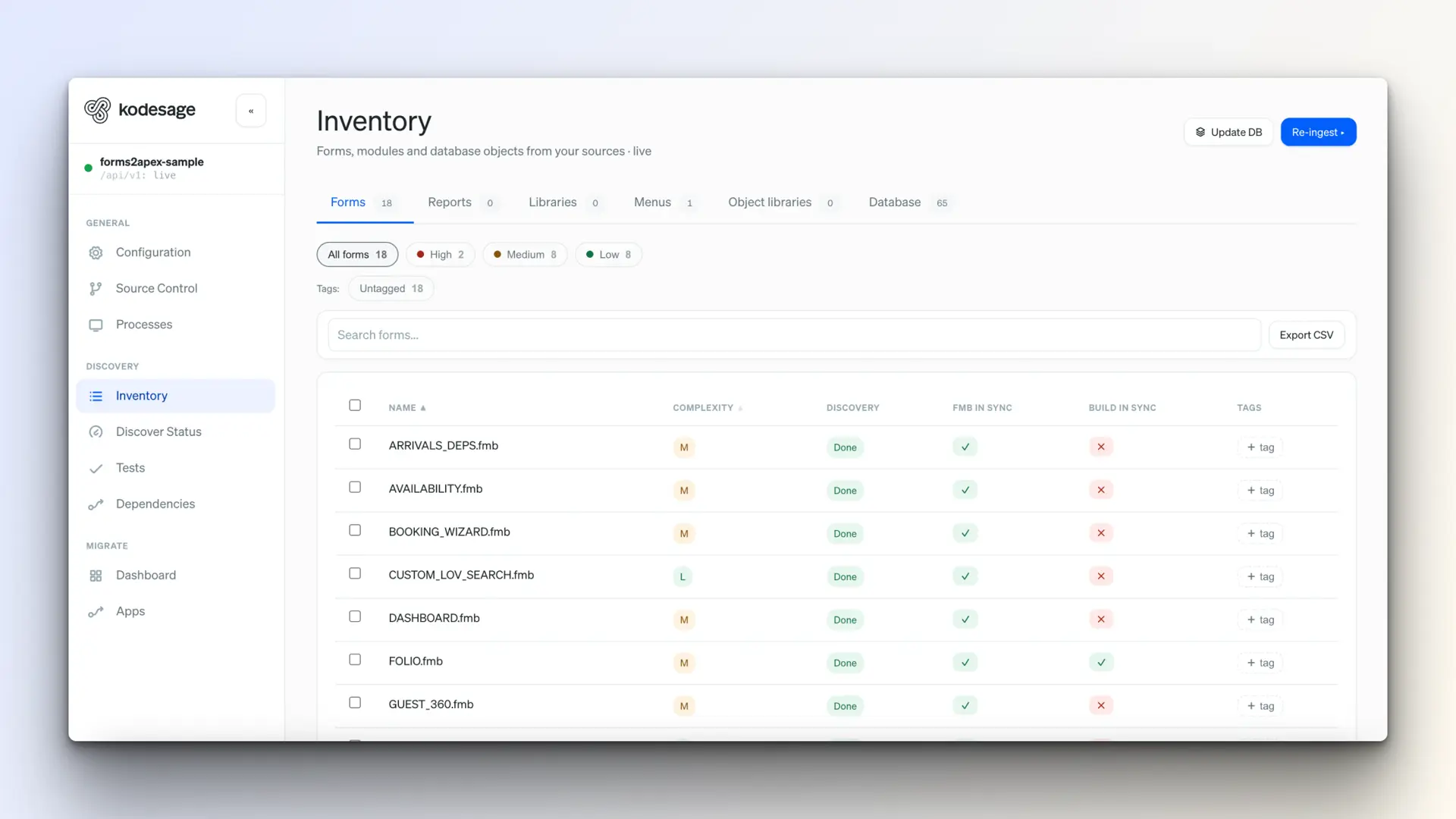
Discovery in practice: the Form & DB inventory
No .fmb files anymore? No problem.
Kodesage can reverse engineer your system from the running application.
To migrate Forms, a model has to read your business logic. In 2026, Microsoft's Satya Nadella warned that enterprises pay for AI twice: once in money, and again in the knowledge they hand over. Kodesage runs on-premises or in your private cloud, air-gapped if needed, so code, prompts and corrections never leave your environment. Agents run sandboxed, with read-only SQL and every change in version control.
One Forms portfolio, your choice of target stack
- Target
Oracle APEX
Stay on the Oracle platform and reuse your PL/SQL.
- Target
Java Spring Boot
An open stack, with a React or Angular front end.
- Coming soon
.NET
For teams standardizing on Microsoft.
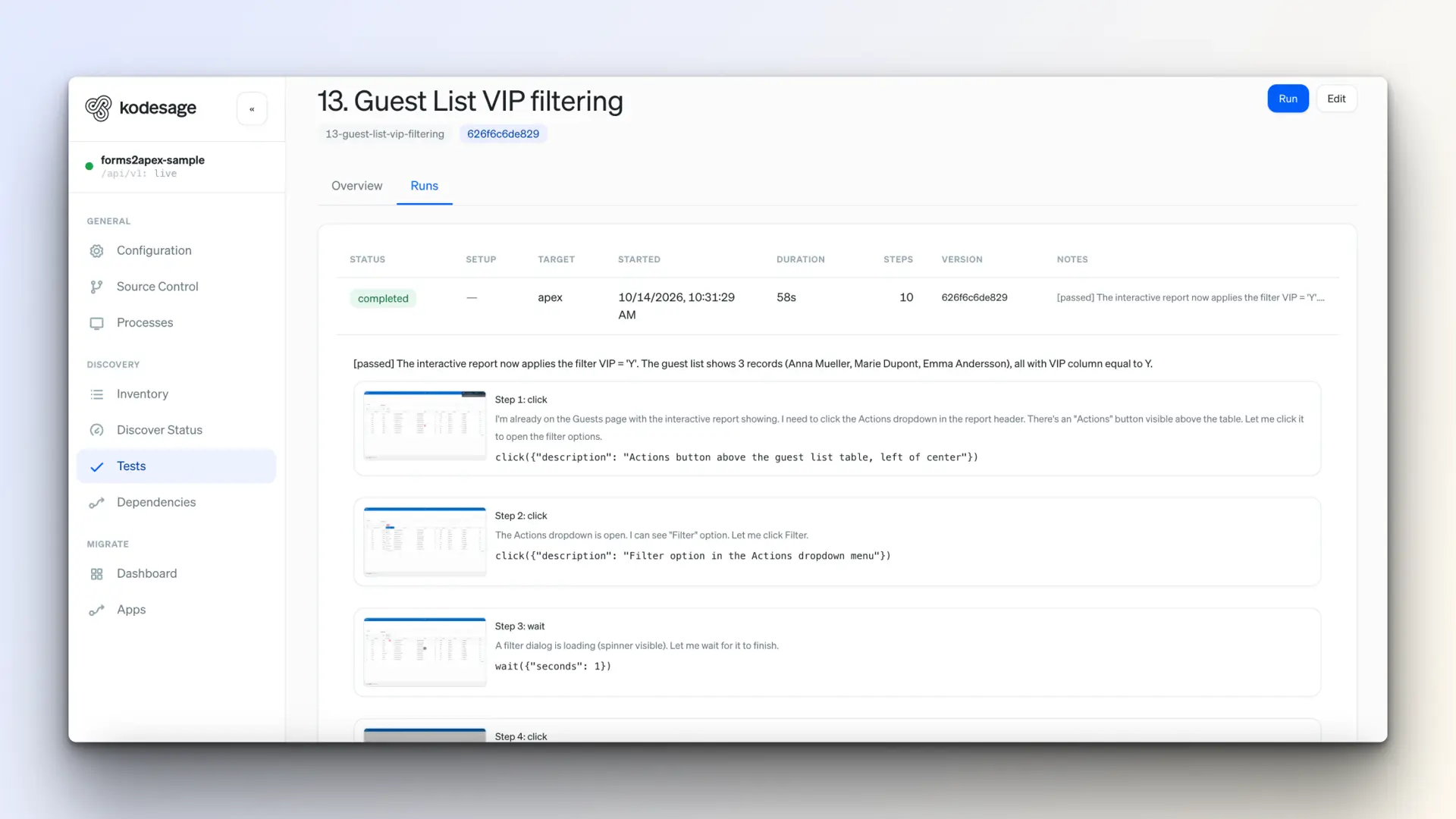
Validation in practice: a Klicker agent test run
The Klicker agent follows a natural-language test scenario, written in whatever language your team works in. It records a screenshot and its reasoning for every step, and returns a verdict for an engineer to review. Because it reads the screen like a user, it works on thick-client Forms setups as well as on web applications.
Keep Forms supportable while you plan the move
Budgets, upgrade projects or other priorities can push a migration back. Meanwhile, change requests keep coming, and the risk grows if only one supplier or a few people can handle them. Kodesage works on the system you have today.
A knowledge base you own
Built from source code, database schemas, documentation and tickets, and updated as the code changes. Ask how a module works, what it touches and why a rule exists.
From ticket to fix
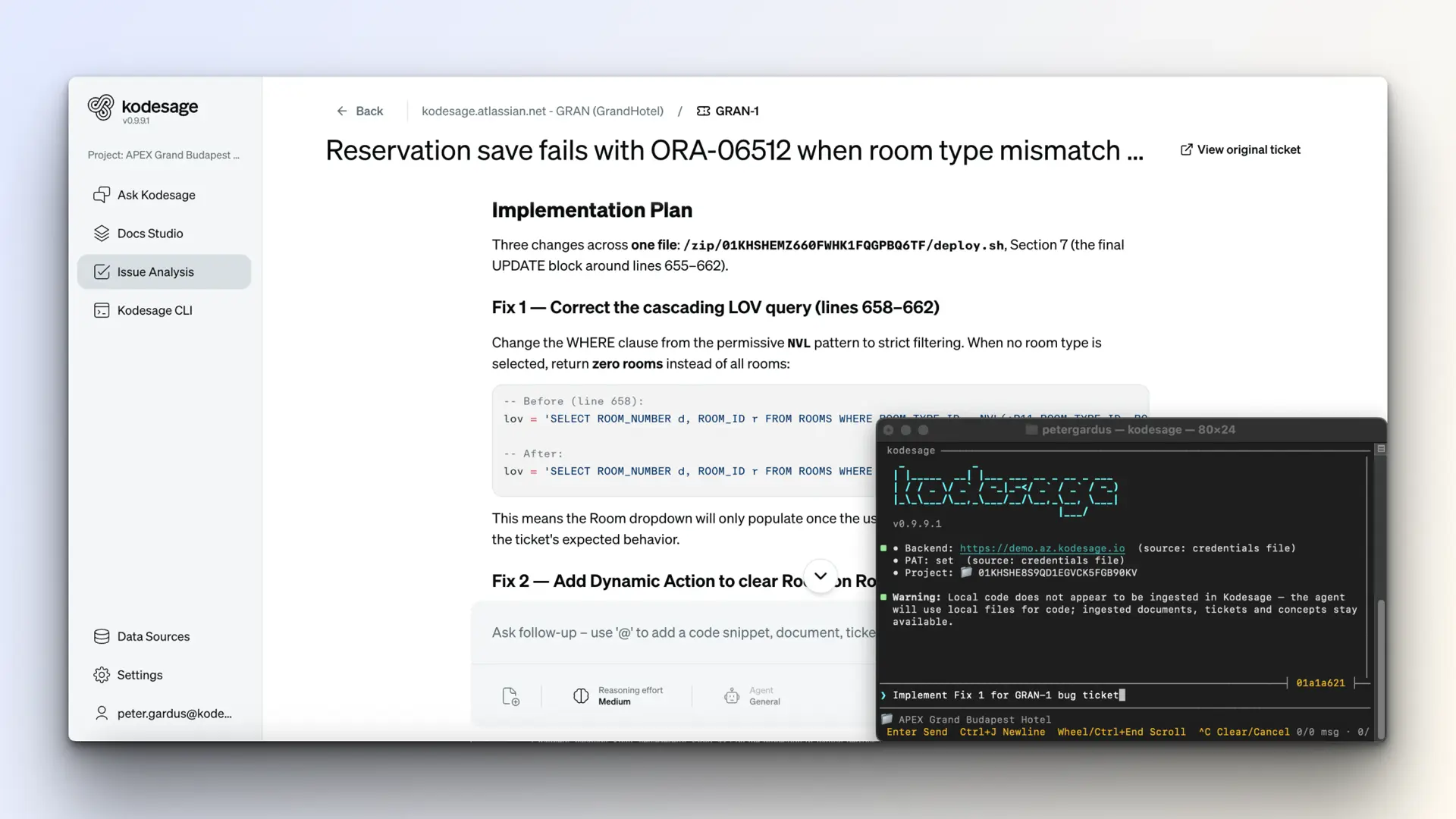
Issue Analysis reads tickets in Jira or your ticketing system and proposes a fix. The AI coding assistant then helps build it, cutting time to fix by up to 60%.
UI testing, even on Forms
Klicker reads the screen like a user, so natural-language test cases run on the Forms thick client as well as on modern web apps.
Documentation that keeps up
Docs Studio documents the system automatically and keeps it in sync, so your people review documentation instead of writing it.
Reduce your dependence on one supplier
Many Forms portfolios are maintained by a single external supplier or a handful of contractors who hold the knowledge in their heads. Once that knowledge sits in a documented base you control, you can bring new engineers up to speed, change suppliers or take work in-house. The same platform carries over to the new application after migration.
When a ticket and the system knowledge are enough to define the fix, Kodesage can analyze it, build the change, deploy it to test and run the tests, then hand the result to an engineer to approve, adjust or send back.
Four things to take away
- 01Forms 12c leaves Premier Support on 31 December 2026, and paid Extended Support ends a year later.
- 02A Forms migration is a knowledge problem first. Start with discovery, not with code.
- 03AI speeds migration up when it works inside deterministic rules, with people deciding what is ambiguous.
- 04Keep your code and business logic in your own environment, on a model you choose.