- Reading time:
- 11 minutes
Share this post
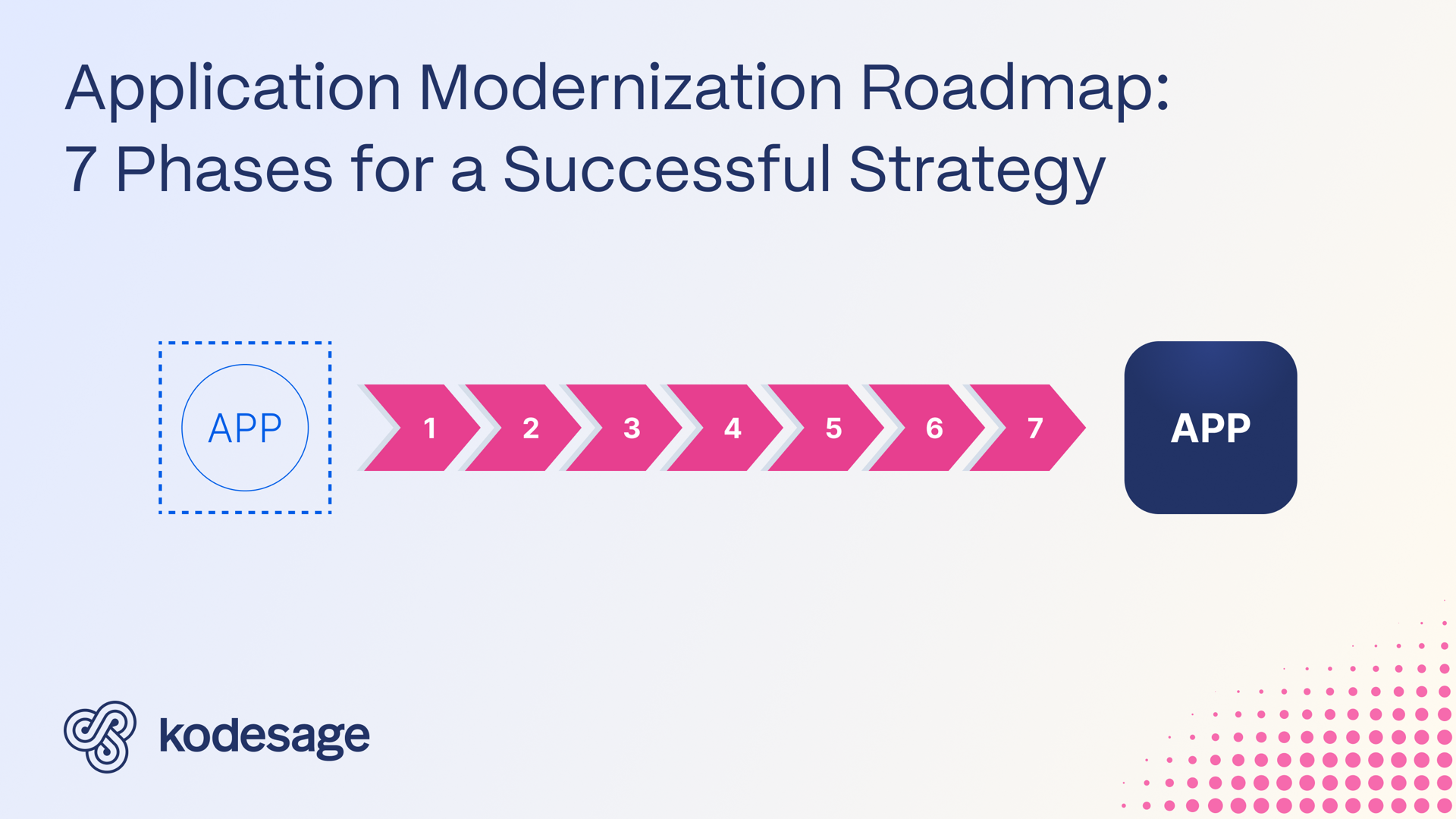
Application Modernization Roadmap: 7 Phases for a Successful Strategy
8 September 2026

Richard Katona
Head of Product Delivery
Many modernization programmes fail due to incomplete audits that missed hidden dependencies. Business Wire says 74% of organizations who start a legacy modernization project never finish it. In this article we cover seven phases for planning a modernization roadmap.
Quick summary
This article outlines a 7-phase application modernization roadmap to help teams systematically upgrade legacy systems with lower risk. It explains why structured modernization is critical for cost control, agility, and reducing system failures. Readers are guided through key actions like assessment, dependency mapping, and phased rollout. For deeper insights and practical guides, explore more resources on our blog.
Trying to build an application modernization roadmap without creating more risk?
Application modernization projects often stall early. According to the 2024 State of the CIO survey, 24% of CIOs say reinventing infrastructure and applications to meet new requirements is a challenge holding IT back. Teams are often working with legacy systems that lack documentation, hide critical dependencies, and contain business logic no one has mapped in years.
A strong application modernization roadmap brings structure to the process. It helps teams reduce uncertainty, align technical work with business goals, and move forward in clear phases.
In this Kodesage article, we’ll walk you through the 7 essential phases of creating an application modernization roadmap, so you can stop treating modernization like a large migration event.
Why listen to us?
Kodesage helps enterprise teams modernize legacy systems they cannot afford to disrupt. We focus on the hardest parts of the process: understanding undocumented systems before major changes begin and providing context-aware assistance throughout the process.
Our platform helps teams collect system knowledge, extract business logic, and map dependencies by analyzing the codebase, database schemas, any existing documentation, and issue tickets to build a queryable knowledge base and generate audit-ready documentation that stays current as changes ship.
We run this discovery automatically, mapping the system's architecture, its business concepts, and the code that implements them into a single connected view, so the business logic doesn't just get extracted once but stays up to date as the system changes. That gives us practical insight on what helps modernization projects move forward with less risk.
What is an application modernization roadmap?
An application modernization roadmap is a phased plan for moving legacy applications from their current state to one that is more secure, maintainable, and scalable. It helps teams decide what to modernize, in what order, which strategy to use, and who is responsible at each stage.
More than a list of technical tasks, a good roadmap connects business goals like cost control, compliance, and long-term value to the work of rehosting, replatforming, refactoring, or replacing systems. It gives architects, engineering leaders, and business stakeholders a shared plan before changes begin, helping them align on priorities instead of reacting to technical debt one issue at a time.

Without that structure, modernization can turn into a series of disconnected projects where teams chase urgent problems, miss dependencies, and lose control of budgets.
Why you need an application modernization roadmap
Modernization without a roadmap is guesswork at scale. Business Wire reports that 74% of organizations start a legacy system modernization project but fail to finish it, often because teams launch without a plan that aligns business and technical leadership.
A clear plan protects your business in several ways, letting you:
- Stay competitive: Modern systems support faster product cycles and better customer experiences.
- Control cost: Phased execution prevents budget overruns from surprise dependencies.
- Reduce risk: Dependency mapping surfaces what a change will affect before deployment.
- Scale safely: Modular architectures replace brittle monoliths over time.
- Allocate resources: Clear phases let leaders time funding, hiring, and partner support.
Teams also need a roadmap to sustain momentum, with modernization often taking 12 to 36 months, without visible milestones leadership loses patience and engineers lose focus.
A roadmap turns the work into a program people can track across every phase.
The 7 phases of an effective application modernization roadmap
Phase 1: Audit and assess existing applications
The first phase is building a clear view of the application portfolio. Teams need to identify each application, its owner, users, business value, tech stack, support status, costs, risks, dependencies, security exposure, unsupported components, and the people who understand how each system works.
This matters because teams cannot prioritize or sequence modernization work without reliable system visibility. It also helps reveal early surprises, such as duplicate applications, undocumented integrations, or low-profile systems that still support billing, reporting, or other critical workflows.

Manual audits for legacy systems, such as those built with Oracle Forms, PL/SQL, COBOL, PowerBuilder or Delphi, can take time and still miss hidden logic or dependencies.
By analyzing the codebase, database schemas, existing documentation, and ticket history, Kodesage makes complex systems easier to assess and surfaces critical business logic before major changes begin.
Tools for AI code review and AI documentation for legacy code, such as Kodesage’s Docs Studio, support early system understanding, improving audit quality drastically.
Phase 2: Set clear goals and uncover dependencies
Once the application portfolio is visible, the next step is setting clear goals and gaining a deeper understanding of how systems work. Teams need to trace interfaces, data flows, integrations, and business rules that may be buried in code or scattered across tickets and old documentation. At the same time, they need to turn business priorities into measurable targets.
That usually means setting goals around:
- Performance and uptime
- Cost and maintenance effort
- Security and compliance
- Business outcomes like delivery speed or onboarding time
This phase matters because teams cannot choose the right modernization path with unclear goals or incomplete system knowledge. It also helps align stakeholders around what success should look like.
It is also a major risk-reduction step. Only because an application appears to be a closed system, doesn’t mean it has no hidden dependencies or downstream effects on customer-facing services or reports. Kodesage makes this point in its legacy modernization guidance, including an Oracle Forms example where weak documentation and hidden dependencies increased migration risk.
To discover dependencies, Kodesage's concept collector runs an automated discovery process across the codebase and database schemas, identifying domain concepts and mapping them against both the system's architecture and its underlying code. This mapping surfaces a dependency a manual review might miss, including what business concept the relationship represents. That means migration targets get set based on how the system works, not on assumptions.

Phase 3: Define business goals, success metrics, and guardrails
After understanding the system, define why you’re modernizing and how success will be measured. This step aligns technical work with clear business outcomes like lower costs, faster delivery, improved reliability, stronger security, and better user experience.
Set measurable KPIs such as response times, deployment frequency, incident reduction, or cost per transaction. These metrics help track progress and prove value.
Next, define guardrails early, including acceptable downtime, compliance requirements, security standards, and go-live criteria. These limits reduce risk and prevent scope creep during execution.
Finally, align engineering, business, and operations teams on priorities and trade-offs. This ensures everyone shares the same definition of success and can evaluate decisions against real business impact throughout the modernization process.
Phase 4: Choose the right modernization strategy for each application
Not every application needs the same path. Different systems deliver value in different ways and carry different levels of technical debt and business risk.
The 6 Rs framework is the clearest way to make those calls:
Strategy | Best when | Avoid when |
|---|---|---|
Rehost (lift and shift) | You need speed and minimal disruption moving to cloud infrastructure | The application has poor performance or heavy technical debt that will follow it |
Replatform | You want cloud benefits with light runtime changes like containers or a managed database | Full re-architecture is needed to unlock scale or feature velocity |
Refactor | Core code still works but the architecture blocks scale, testing, or integration | Business logic is poorly understood, since rewrites without clarity fail fast |
Rebuild | The application no longer meets business needs and fixing it costs more than rewriting | A proven SaaS tool could replace it with less risk and cost |
Repurchase | A strong off-the-shelf tool already covers the workflows | Heavy customization is a core competitive differentiator |
Retire | The application adds no business value and usage has declined | Users still depend on it daily or it stores critical records |
Teams often default to the fastest visible move, especially rehosting. AWS warns that rehosting alone does not guarantee the broader business benefits organizations expect from modernization. In some cases it is the right short-term step. In others it simply relocates technical debt into a new environment.
A better lens compares effort, risk, and value together. Low-value applications may be retirement candidates. Stable applications with modest risk suit rehosting or replatforming. High-value systems with deep technical debt may need refactoring, rebuilding, or more discovery before any decision is safe.
Most enterprises end up with a mix: a call center tool retired, a core accounting system refactored, a customer portal rebuilt. The right choice depends on the insights from Phases 1 and 2. See our guide on refactoring legacy code for deeper technical detail, or our shortlist of enterprise modernization platforms.
Phase 5: Design the target architecture and rollout plan
Once the strategy and architecture are defined, teams can start rolling out changes in phases. This usually begins with a pilot or proof of concept before moving into larger modernization waves.
A strong rollout plan accounts for:
- Shared services and integration contracts
- Data dependencies and cutover sequencing
- Compliance controls that constrain what moves first
- Testing windows and business timing
- Rollback paths when something breaks
As systems go live, teams should track performance against earlier goals, including system performance, user adoption, incident rates, and cost. These metrics show whether the business case still holds and where the next wave needs adjustment.

This matters because modernization is an ongoing program, not a one-time project. Early results validate assumptions, build stakeholder trust, and catch issues before they spread.
While the system changes with every wave, Kodesage maintains its knowledge base throughout, reducing the risks that arise from outdated documentation and a lack of system understanding. Furthermore, it also provides detailed migration guides. These guides have been configured based on real migration projects plans, and can be easily customized to a specific project. Armed with full system level context, customized migration guides can speed up the planning process significantly.
Phase 6: Execute in phases with documentation, testing, and change control
Avoid modernizing everything at once. Pick a pilot with moderate complexity and limited blast radius.
Execution covers more than migration tasks. A strong plan includes:
- Proof of concept for each major technology choice.
- Dedicated environments for testing and rollback.
- Acceptance criteria per release.
- Communication plan for business users.
- UAT, regression testing, issue triage, and governance around production change.
When it comes to issue triage, Kodesage connects to ticketing systems, including Jira and Redmine, to support the ticket workflow during ongoing production and maintenance. Its Issue Analysis provides AI-generated ticket summaries and fix suggestions, so production issues get resolved with system context instead of guesses, reducing time-to-fix by up to 60%.

User acceptance testing is also one of the biggest time sinks in this phase. Instead, Kodesage's Klicker uses computer vision to execute UI tests, automating and accelerating UAT.
Documentation must not be an afterthought. Kodesage's Docs Studio generates and updates documentation automatically as code or data model change, reducing manual documentation effort by up to 90% and keeping teams audit-ready without slowing delivery.
Once the pilot proves the approach, expand to the next wave. Group applications by dependency so related systems move together. Early wins also build political momentum for continued investment.
Phase 7: Measure outcomes and continuously improve
Modernization does not end at launch. The final phase is locking in gains, measuring outcomes, and improving the system over time.
Teams should track KPIs such as performance, cost, reliability, delivery speed, compliance fit, and user impact. Comparing results against the baseline helps prove whether the business case still holds and gives leadership a clear view of progress.
Our guide on legacy modernization challenges covers the risks that often surface in this phase.
This phase is also about watching for drift:
- Performance can regress after releases
- Documentation can fall out of sync with code
- Ticket volume can rise in specific modules
- Engineers may still depend on a few senior team members for basic context
These are signs that the roadmap needs adjustment. Teams should complete the transition by retiring legacy systems instead of keeping them running “just in case.” Lessons from earlier phases should become patterns, templates, and playbooks that make future modernization work faster and more predictable.
Knowledge retention matters here. This is where the knowledge base and the documentation platform serves an important purpose, keeping documentation current as systems change and sharing system knowledge across the team, instead of concentrating it with a few people.
Build your application modernization roadmap with Kodesage
A roadmap is only as strong as the understanding it is built on. Surface-level audits produce surface-level plans, which is where most programs stall.
Kodesage helps enterprises overcome this pitfall by building a knowledge base that holds deep system intelligence extracted from the source code, database schemas, documentation and issue tickets. The knowledge base serves as the foundation for Docs Studio, Issue Analysis and Ask Kodesage, an interface to ask questions about any part of the system in natural language.
Because the platform deploys on-premises or in a private cloud, including air-gapped environments, that intelligence stays inside your infrastructure instead of a shared cloud service, a meaningful distinction for teams whose legacy systems are also their most sensitive ones.
Deep understanding of a legacy system is a requirement for any successful modernization project. Establishing it before refactoring begins is what turns a roadmap into something a team can execute, with less risk and fewer surprises.
Ready to modernize your legacy systems with confidence? Request a demo today and see how Kodesage can support your roadmap.
FAQ
How do you prioritize applications in a modernization roadmap?
Rank applications by business criticality, production incident volume, and technical debt. Kodesage's legacy modernization platform surfaces these signals across your portfolio so you can rank with data, not opinion.
Can legacy systems be modernized without rewriting code?
Yes. Rehosting and replatforming move applications to modern infrastructure with little or no code change, and Kodesage's Ask Kodesage helps teams understand the code before touching it so any path carries less risk.
How often should you update an application modernization roadmap?
Review the roadmap quarterly and update it whenever priorities, compliance rules, or a phase closes. Kodesage keeps system documentation current as code changes, so your roadmap reflects reality, not a six-month-old snapshot.
How does AI accelerate application modernization?
AI speeds up the hardest parts of modernization: code comprehension, dependency mapping, documentation, and impact analysis. Our guide on refactoring legacy code covers how AI fits into a safer refactor process.
What tools support an application modernization roadmap?
The right tool depends on the phase: code intelligence for discovery, documentation and integration for execution, issue analysis for ongoing work. Our shortlist of enterprise modernization platforms compares eight options, including where Kodesage fits best.
Why choose Kodesage?
Deep Legacy Code Intelligence
Kodesage supports legacy stacks like Oracle Forms, COBOL, PowerBuilder, SAP, PL/SQL, and also modern stacks.
Secure On-premise Deployment
Single tenant application, offering both VPC and fully on-premise deployments meeting the strictest security requirements.
Living Knowledge Base
Connect to the entire codebase, issue ticketing systems like Jira, databases, tests, wikis like Confluence and upload documents.
Automated Documentation
AI generated software documentation that is always up to date with a pre-built and editable document template library.

Regression Test Automation
Automate regression and unit test coverage, accelerate releases and ensure traceability for future audits.
AI-powered Issue Ticket Analysis
Native integration to systems like Jira, and AI-generated fix recommendations for tickets.
Start transforming your legacy systems
With Kodesage teams maintain legacy projects more efficiently, and modernize faster.
See it in action today.